
AI Overviews Are Eating Your Clicks: The 2026 SEO Survival Guide
For twenty years, the SEO contract was simple. Rank number one, earn the click. Google kept its share of attention, publishers kept theirs, and everyone understood the deal.
That contract is now broken, and the data proves it.
In February 2026, Ahrefs published an update to its AI Overviews research that should alarm every business relying on organic search. Across 300,000 keywords analyzed with Google Search Console data, AI Overviews now reduce the click-through rate of the top-ranking page by 58%. Eight months earlier, that figure was 34.5%. The damage nearly doubled in under a year, and it is still accelerating.
This is not a future threat. It is the current operating environment. This guide breaks down exactly what the research shows, who gets hurt worst, what actually earns citations inside AI Overviews, and the seven tactics that form a working survival playbook. Every claim below is tied to a real study. No speculation dressed as data.
1. The Click Is Dying: What the Numbers Actually Show
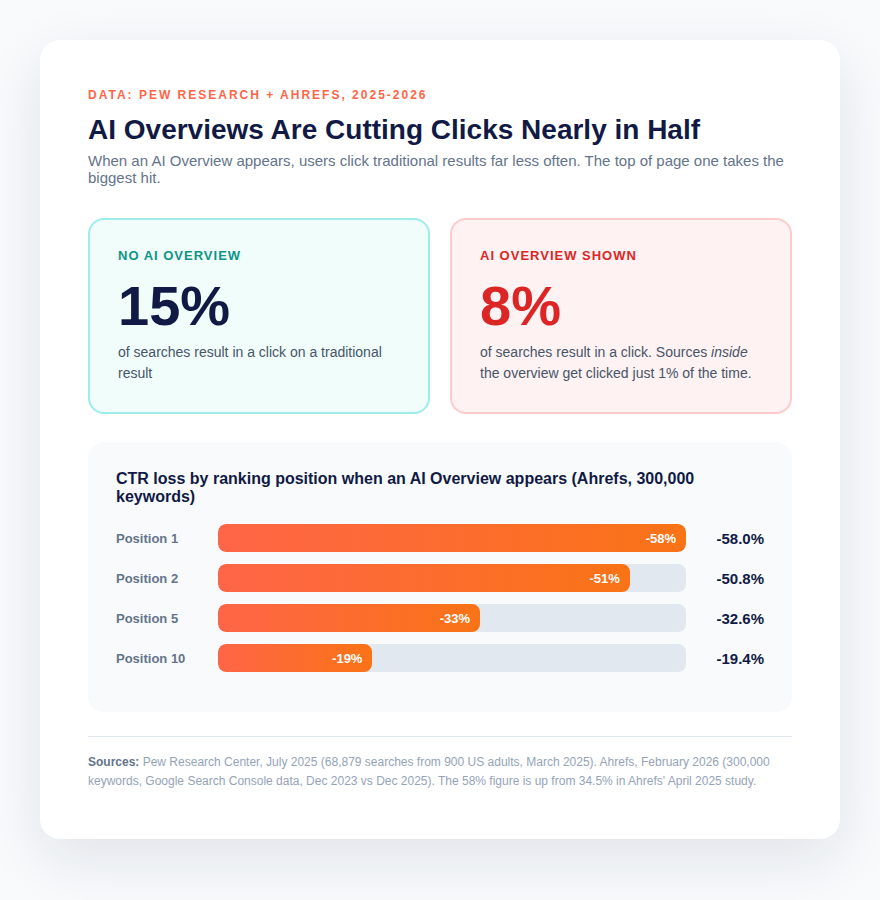
Start with the most rigorous independent measurement available. In July 2025, the Pew Research Center published a study based on the real browsing behavior of 900 US adults, tracked across 68,879 Google searches in March 2025. This was behavioral observation, not a survey, which makes it unusually trustworthy.
The headline finding: when an AI summary appeared in the results, users clicked a traditional search result only 8% of the time, compared with 15% on pages without a summary. Clicks were nearly cut in half.
Three details from the Pew study deserve attention:
First, the links inside AI Overviews, the cited sources Google shows as evidence, were clicked just 1% of the time. Being cited is not the same as being visited. The citation is a brand impression, not a traffic channel, at least in its current form.
Second, users who saw an AI summary were far more likely to end their browsing session entirely: 26% stopped after a page with an AI summary, versus 16% on standard results pages. The summary satisfied them. They left.
Third, AI Overviews appeared in 18% of all searches in the study period, but the distribution was lopsided. Only 8% of one- or two-word queries triggered a summary, while 53% of searches with ten or more words did. Question-format queries beginning with “who,” “what,” or “why” triggered summaries 60% of the time. The longer and more question-like the query, the more certain the AI Overview.
Ahrefs added the ranking-position dimension. Its February 2026 update measured CTR impact across all ten organic positions, and the damage extends well beyond position one:
| Position | CTR change with AI Overview |
|---|---|
| 1 | -58.0% |
| 2 | -50.8% |
| 3 | -46.4% |
| 5 | -32.6% |
| 10 | -19.4% |
For informational keywords that trigger AI Overviews, the average position-one CTR collapsed from 7.6% in December 2023 to just 1.6% in December 2025. For every 100 clicks a top-ranking page historically earned, Google now keeps 58.
Seer Interactive corroborated the scale independently. Analyzing 25.1 million organic impressions across 42 organizations, Seer found organic CTR for queries with AI Overviews fell from 1.76% to 0.61% between June 2024 and September 2025, a 61% decline. Notably, even queries without AI Overviews saw CTR fall 41% in the same window, suggesting broader shifts in search behavior compound the problem.
Semrush, measuring 69 million sessions from May to July 2025, found the zero-click rate rising from 60% in standard search to 83% when an AI Overview appears, and 93% in AI Mode, where the entire page becomes a conversation.
The France natural experiment removed any remaining doubt about causation. When AI Overviews launched in France on July 22, 2026, Ahrefs was already tracking 963 domains. Within nine days, the domains most exposed to AI Overviews lost 23.1% of their click-through rate, six times the market average. Among highly exposed domains, 82.2% lost CTR. This was not an algorithm update or seasonal swing. It was the Overview.
One paradox deserves mention: Google processes more searches than ever, an estimated 13.6 billion per day in 2025, up from 8.5 billion in 2024. People search more. They click less. Volume is up, clicks per search are down, and the gap between those two lines is where publisher traffic used to live.
2. What AI Overviews Are and How Widespread They Have Become
An AI Overview is Google’s AI-generated answer block, powered by Gemini, that appears above organic results for many queries. It synthesizes information from multiple sources into a conversational summary, typically around 67 words long, with inline citations linking to source pages. Pew found 88% of summaries cite three or more sources.
Google launched AI Overviews broadly in the US in May 2024. By 2026, they appear across some 200 countries in 40 languages. Google reported at I/O 2026 that AI Mode alone had passed one billion monthly users, with queries more than doubling every quarter.
Trigger rates vary enormously by query type, which matters for strategy. The vertical breakdown from Semrush’s 2025 research is stark:
| Query vertical | AI Overview trigger rate |
|---|---|
| Health-related | 88% |
| People and society | 67% |
| All queries (March 2025) | 13.14% |
| All queries (January 2025) | 6.49% |
Note the trajectory in that last pair: the overall trigger rate doubled from 6.49% to 13.14% in two months. By 2026, independent tracking put AI Overviews on roughly 26% of US searches and nearly half of tracked commercial queries, depending on methodology. The direction is uniform even where exact figures differ by measurement method.
- Health queries: 88% trigger rate (Semrush 2025), the highest of any vertical. Medical and wellness content is almost always summarized.
- Question queries: 60% trigger rate for “who,” “what,” “why” formats (Pew 2025).
- Long queries: 53% for searches of ten or more words, versus 8% for one or two words (Pew 2025).
- Comparison queries: roughly 95% trigger AI Overviews, and question-format queries trigger them about 86% of the time (2026 industry data).
- Overall: around 18% of all searches in early 2025 (Pew), rising toward 26% of US searches and roughly 48% of tracked commercial queries by 2026, depending on the measurement methodology.
The practical takeaway: if the business depends on informational content, long-tail question queries, or comparison content, AI Overviews are not an edge case. They are the default rendering of the search results page.
There is also a second-order effect worth understanding. Google’s AI Mode, a conversational search experience, generates zero-click rates around 93%. As AI Mode adoption grows, the habits users form there, expecting complete answers without clicking, bleed back into standard search behavior. The Seer finding that even non-AI-Overview queries lost 41% of CTR fits this pattern. User expectations are shifting faster than any single SERP feature.
It helps to distinguish the two surfaces clearly. AI Overviews are synthesized summaries injected above traditional results; the classic ten blue links still exist underneath. AI Mode replaces the results page with a conversation, where follow-up questions generate further synthesized answers and clicks become rarer still. Strategy differs slightly: Overviews reward extractable passages on ranking pages, while AI Mode rewards entity authority and conversational answer coverage across the fan-out of follow-up questions. Both reward the same underlying assets, which is why the playbook in section 5 addresses them together.
A technical footnote that saves wasted effort: Google’s Gary Illyes has confirmed that normal SEO works for AI Overviews and that llms.txt files are not used by Google. Some vendors sell llms.txt deployment as a GEO tactic; for Google specifically, the evidence says crawler accessibility, clean rendering, and standard structured data matter far more. Do not let tooling vendors redirect budget from content quality to speculative technical theater.
3. Who Gets Hurt Most: Informational vs Transactional
The damage is not evenly distributed. Understanding the asymmetry is the foundation of every strategic decision that follows.
Informational queries take the direct hit. Ahrefs’ research focused on informational intent, finding 99.2% overlap between informational keywords and AI Overview triggers. For these queries, the AI Overview directly substitutes for the click: the user wanted an answer, the summary provided it, the session ended. Amsive’s analysis of 700,000 keywords found non-branded keywords suffered a 19.98% CTR decline, worse than the 15.49% average, because non-branded informational queries are exactly where AI Overviews trigger most.
Transactional and commercial queries are partially shielded, for now. Industry data consistently shows transactional queries losing less than 10% of CTR when AI Overviews appear, compared with 34.5% to 58% for informational queries. The reason is structural: a user searching “buy running shoes size 10” still needs to transact somewhere. The AI Overview can summarize options, but it cannot complete the purchase. Product pages, local pack results, and shopping units retain much of their click value.
But “shielded” does not mean “safe.” Three erosion vectors are already visible:
- Comparison queries are heavily summarized. With ~95% of comparison queries triggering AI Overviews, the research phase of the buying journey, the “best X for Y” content that feeds commercial intent, is being absorbed. A business that relied on comparison content to capture high-intent researchers is losing that top-of-funnel entry point.
- Branded queries are the last refuge, and they are narrow. AI Overviews trigger far less on branded searches. But branded search volume is a function of unbranded discovery. If AI Overviews intercept the discovery journey, branded searches downstream eventually shrink too.
- Local queries sit in between. Map Pack and Google Business Profile listings generally appear outside the AI Overview block for local-intent queries, which protects “near me” commercial searches. But informational local queries (“how much does roof repair cost”) are fully exposed. For a deeper look at local visibility mechanics, see the analysis of Google Business Profile ranking factors.
The strategic implication is blunt: content portfolios weighted toward informational commodity content, the classic “what is X” and “how to Y” blog strategy, face the steepest traffic declines. Portfolios weighted toward transactional pages, tools, original data, and brand-differentiated content retain more value. The next two sections explain how to rebuild for the new reality.
4. What Actually Earns Citations: Patterns From the Research
If clicks are shrinking, citations become the new visibility currency. Being named inside an AI Overview does not deliver the traffic a ranking once did, but it delivers something else: brand presence at the moment of consideration, authority signals, and, according to multiple studies, higher-intent downstream traffic. Cited pages see click-through rates roughly 2.3 times higher than uncited ones when users do click through.
So what gets cited? Several 2025-2026 studies converge on consistent patterns.
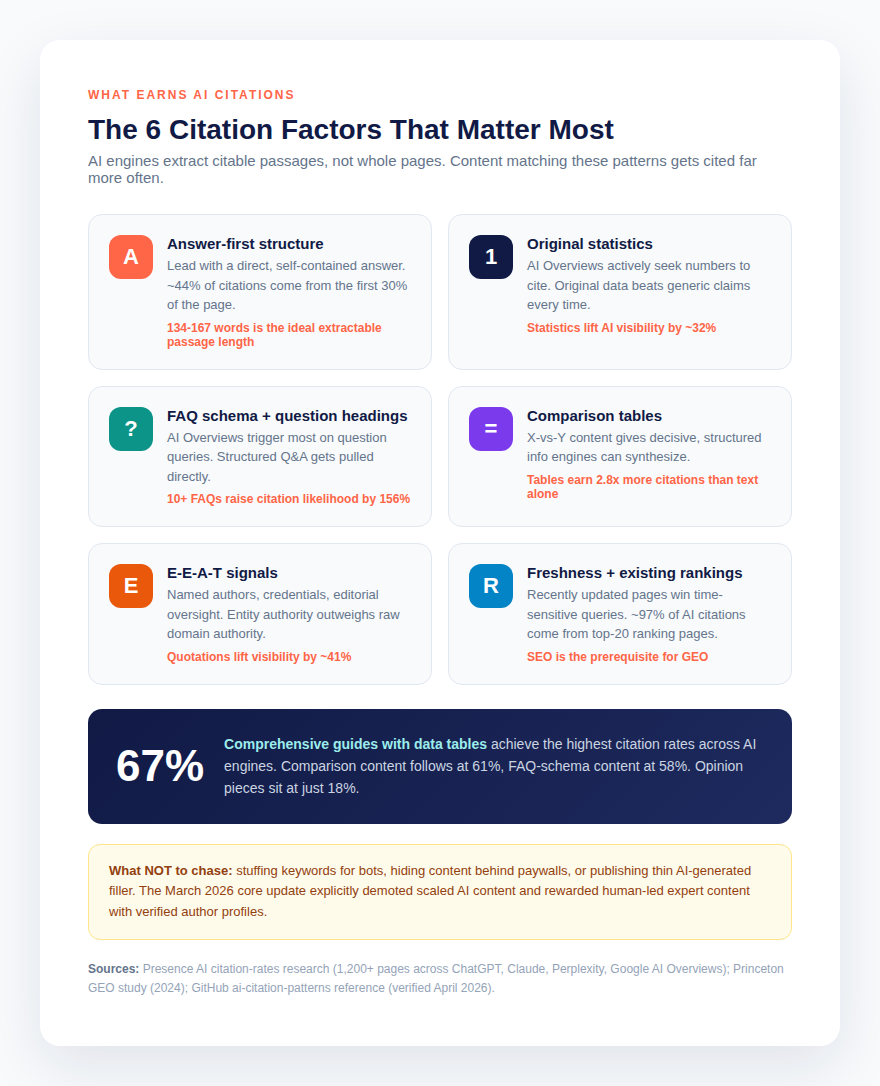
Content type matters enormously. Research analyzing 1,200+ pages across ChatGPT, Claude, Perplexity, and Google AI Overviews found comprehensive guides with data tables achieve the highest citation rates at 67%. Comparison matrices follow at 61%, FAQ-schema content at 58%, and how-to guides at 54%. Opinion pieces and thought leadership sit at just 18%. The lesson: AI engines cite structured, factual, comprehensive content, not hot takes.
Within Google specifically, listicles account for roughly 22% of citations, articles 17%, and product pages 14%. Informational queries pull citations from articles; commercial queries pull from listicles. Reddit (~21%) and YouTube (~19%) are the most-cited single domains, which reveals something important: Google values authentic, experience-based content. Raw human experience, even in informal formats, earns citations because it reads as genuine E-E-A-T.
Passage structure beats page structure. AI engines extract passages, not pages. The research identifies an optimal extractable passage length of 134 to 167 words, and roughly 44% of citations are pulled from the first 30% of the page body. Six recurring patterns appear in cited passages: direct-answer paragraphs of 40-55 words, canonical definition sentences, numbered step lists, comparison tables, attributed quotes, and stat callouts with named sources.
Existing rankings remain the gatekeeper. Around 97% of AI citations come from pages already ranking in the top 20 organic results. SEO is the prerequisite for GEO (generative engine optimization). Content a crawler cannot reach or that ranks nowhere is invisible to AI engines too. This is the single most misunderstood point in the GEO conversation: it is a layer on top of SEO, not a replacement.
E-E-A-T signals carry more weight than raw domain authority. Named authors with credentials, quotations from identifiable experts, and editorial oversight correlate strongly with citation. The original Princeton GEO study quantified this: quotations lifted AI visibility by around 41%, statistics by 32%, and source citations by 30%. The March 2026 core update reinforced the direction, rewarding human-led expert content with verified author profiles and demoting scaled AI content.
Freshness and schema provide measurable lifts. FAQ sections with 10+ questions increase citation likelihood by 156%. Pages with comparison tables achieve 2.8x higher citations than text-only equivalents. Clear H2/H3 hierarchy correlates with 3.2x higher citation rates. Google AI Overviews specifically prioritize FAQ-schema content, showing 71% citation rates when properly implemented.
5. The GEO Playbook: 7 Tactics That Actually Work
Generative engine optimization, named in a Princeton paper in late 2023 and now a mainstream discipline, is the practice of earning citations inside AI-generated answers. The tactics with the strongest evidence are unglamorous. They compound.
Tactic 1: Restructure every key page answer-first
Rewrite top pages so each section leads with a direct, quotable answer in 15-25 words, followed by supporting detail. Kill throat-clearing intros. The first paragraph under every H2 should make sense as a standalone snippet, because that is exactly how AI engines will use it.
Bad: “In this comprehensive guide, we will explore the various factors that influence keyword difficulty and discuss how different elements come into play.”
Good: “Keyword difficulty measures how hard it is to rank on page one for a given keyword, scored 0-100. Scores under 30 are generally achievable for new sites with focused content.”
Every H2 section should answer exactly one question. Multi-question sections get partial citations or none.
Tactic 2: Publish original statistics with named attribution
AI Overviews actively hunt for numbers to cite. A page containing “According to [Brand]’s 2026 analysis of 1,000 listings, review velocity correlates with local pack presence” is citable in a way that “reviews are important for local SEO” is not. Original research, surveys, and proprietary data analysis are the highest-leverage content investments in the AI era because they create citation assets competitors cannot replicate.
Format statistics as clean, attributable claims: source, sample size, finding. Avoid hedging language at the start of citable passages. “Maybe” and “perhaps” get cited less.
Tactic 3: Build FAQ sections with 10+ questions and proper schema
AI Overviews trigger most aggressively on question queries, and FAQ-structured content with schema markup is pulled directly into answers. Add genuine FAQs, not keyword-stuffed filler, to every important page: 10 or more real questions the audience actually asks, each answered in two to three crisp sentences, marked up with FAQPage schema.
This single tactic delivered a 156% citation likelihood increase in the Presence AI research. It is also the cheapest to implement.
Tactic 4: Create comparison tables for every X-vs-Y query in the niche
Comparison queries trigger AI Overviews at roughly 95%, the highest rate of any query type, and comparison tables earn 2.8x more citations than text-only content. For every meaningful comparison in the category, build a dedicated page or section with a real table: features, prices, pros, cons, verdict. Structure is what makes it extractable.
Tactic 5: Attach names, credentials, and quotations to expertise
E-E-A-T is not an abstract ideal in the AI era; it is a retrieval signal. Pages with named authors, visible credentials, and attributed expert quotations get cited more. Quotations alone lifted AI visibility ~41% in the Princeton research. Add author bylines with verifiable profiles, quote practitioners by name, and link claims to authoritative sources. Content that itself demonstrates sourcing discipline gets trusted by synthesis engines.
For service businesses, this extends to the whole domain. Consistent entity signals, an unambiguous about page, coherent profiles across the web, and genuine reviews all feed the entity resolution that determines who gets cited. This is also why a technically sound SEO foundation remains non-negotiable: engines cannot cite what they cannot cleanly retrieve and attribute.
Tactic 6: Cover the query fan-out, not just the headline query
A generative engine does not run the user’s literal question against an index. It decomposes the question into sub-queries, retrieves for each, then synthesizes. “What is the best CRM for small teams” becomes something like three separate retrievals: “best CRM 2026,” “CRM small business,” “CRM pricing comparison.” Content that answers only the literal headline query is invisible to most of the fan-out. Map the two or three sub-questions beneath every target query and answer each explicitly, with its own heading.
Tactic 7: Maintain a freshness cadence on high-value pages
AI engines disproportionately cite recently updated pages for time-sensitive topics. An article from 2021 may still rank, but it is far less likely to appear in an AI Overview for a topic that has evolved. Identify the 20% of pages driving 80% of organic value and put them on a quarterly refresh cycle: update statistics, add new sections addressing fan-out sub-questions, refresh the publication date honestly. Publish-and-forget is a citation death sentence.
6. What to Stop Doing
Equally important is the stop-doing list. Several once-standard practices now actively waste resources or backfire.
Stop investing in commodity informational content. The “what is X” article that 50 competitors have already written, with no original data, no named expertise, and no structural advantage, will be summarized, not clicked. Either make informational content citation-worthy through original research and structure, or redirect that budget toward content formats AI cannot fully substitute: tools, calculators, original studies, and brand-differentiated perspectives.
Stop publishing thin AI-generated filler at scale. The March 2026 core update explicitly demoted scaled AI content. Beyond the ranking risk, thin content is nearly invisible to citation engines, which select for depth, structure, and verifiable expertise. One deeply researched article outperforms twenty shallow ones in both rankings and citations.
Stop burying answers. Intros that spend 200 words warming up before delivering value were always weak; now they are fatal. If the answer is not in the first 30% of the page, the citation probably goes to a competitor.
Stop measuring organic success by sessions alone. When 83% of AI Overview searches end without a click, session counts will fall even for winning strategies. Businesses that judge SEO purely on organic sessions will misread a successful GEO program as a failure and kill it. The measurement section below fixes this.
Stop ignoring branded and entity building. As unbranded informational discovery gets intercepted, the businesses that survive are the ones users search for by name. Digital PR, genuine reviews, podcast appearances, and community presence are no longer “brand marketing” separate from SEO. They are retrieval signals. Earned media has become a citation signal.
This connects to an uncomfortable finding in the citation research: Reddit and YouTube are the most-cited single domains in AI Overviews, at roughly 21% and 19% respectively. Google’s systems clearly reward authentic, experience-based content, even in informal formats. A brand with zero presence in the communities where its buyers actually talk is ceding citation share to anonymous forum threads. Participation in those spaces, done genuinely rather than as link spam, is now a visibility tactic with measurable return.
Stop treating GEO as a separate team or tool purchase. The strongest predictor of AI citations remains traditional ranking position, with ~97% of citations flowing to top-20 pages. Organizations that spin up an isolated “AI visibility” initiative while neglecting technical SEO, content depth, and link authority build on sand. GEO is a content-structure and authority layer applied on top of functioning SEO, and it belongs inside the existing SEO program, not beside it.
7. How to Measure Success in the AI Era
The old dashboard, rankings plus organic sessions, now lies by omission. A complete measurement framework for the AI era tracks five layers:
1. AI Overview exposure on money keywords. Use Ahrefs’ Site Explorer: open the Organic Keywords report and filter SERP features by AI Overview. This shows exactly which ranking keywords trigger overviews. Segment these from non-overview keywords, because their CTR baselines are now fundamentally different. Review this monthly; trigger rates shift constantly.
2. The impressions-clicks gap in Search Console. For overview-triggering keywords, watch impressions versus clicks over time. A widening gap with stable impressions and rankings confirms AI interception rather than a ranking problem. This distinction determines whether the response is “fix rankings” or “win citations,” which are different workstreams.
A concrete diagnostic: pull a 12-month Search Console comparison for the top 50 informational keywords. If average position is flat or improved while CTR falls disproportionately on exactly the keywords that now show AI Overviews, the diagnosis is interception, not relevance loss. The correct response is citation-asset building on those pages (tactics 1 through 4), not rewriting titles to chase a CTR recovery that the SERP layout no longer permits. Conversely, if CTR is falling on keywords without AI Overviews, check title and meta competitiveness first, since the layout is not the culprit there.
3. Citation and brand-mention tracking. Tools like Profound and Semrush’s AI Toolkit monitor how often the brand is cited across AI engines, ChatGPT, Perplexity, Gemini, and Google AI Overviews. Track citation share against competitors, not just absolute mentions. This is the new share-of-voice metric.
When setting up citation tracking, define the query set deliberately: 20 to 30 high-value questions per product line, refreshed quarterly as trigger rates shift. Manual spot-checks in each engine remain valuable even with tooling, because citation panels render differently across surfaces and tools occasionally miss carousel-format citations.
4. Branded search volume. As discovery gets intercepted, branded searches become the downstream indicator of upstream visibility. Rising branded search volume alongside falling informational sessions can indicate the GEO program is working: users encounter the brand inside AI answers, then search for it directly.
5. Blended business metrics. Tie everything to revenue-influenced outcomes: assisted conversions from organic, demo requests from branded search, and pipeline influenced by content. The businesses thriving in the AI era are the ones that stopped asking “how much traffic did SEO drive” and started asking “how much revenue did search visibility influence.”
The Bottom Line
The data tells a coherent story. AI Overviews have cut top-ranking click-through rates by 58% in under two years, with the damage concentrated on informational queries. Only 1% of users click cited sources inside overviews. Yet the same research reveals the escape route: structured, factual, expert-attributed content earns citations at dramatically higher rates, and 97% of those citations still flow to pages ranking in the top 20.
SEO is not dead. It has been promoted. Rankings are now the prerequisite, and citations are the prize. The businesses that rebuild around answer-first structure, original data, and genuine expertise will own visibility in the AI era. Those waiting for clicks to return are waiting for a world that no longer exists.
—
Sources cited in this article:
- Pew Research Center, “Google users are less likely to click on links when an AI summary appears in the results,” July 2025. https://www.pewresearch.org/short-reads/2025/07/22/google-users-are-less-likely-to-click-on-links-when-an-ai-summary-appears-in-the-results/
- Ahrefs, “Update: AI Overviews Reduce Clicks by 58%,” February 2026. https://ahrefs.com/blog/ai-overviews-reduce-clicks-update/
- Ahrefs, “AI Overviews Cut CTR by 23.1% in France,” 2026. https://ahrefs.com/blog/ai-overviews-france-impact/
- Seer Interactive, “AIO Impact on Google CTR,” September 2025 update. https://www.seerinteractive.com/insights/aio-impact-on-google-ctr-september-2025-update
- Amsive / Search Engine Land, “New data: Google AI Overviews are hurting click-through rates,” 2025. https://searchengineland.com/google-ai-overviews-hurt-click-through-rates-454428
- Presence AI, “AI Citation Rates Research: What Content Gets Cited Most.” https://presenceai.app/blog/ai-search-citation-rates-research-which-content-gets-cited
- Princeton GEO research (2024), via ai-citation-patterns reference. https://github.com/abouchard11/ai-citation-patterns
- Semrush AI Overviews data via SQ Magazine statistics compilation. https://sqmagazine.co.uk/ai-seo-statistics/