
The 90-Day Growth Plan for Service Businesses: One System for SEO, Google Ads, Meta Ads and Reviews
Most service businesses do not have a traffic problem. They have a sequence problem. Ads start before tracking works, SEO starts before the pages exist, reviews happen by luck, and every channel is judged alone, in the wrong order, against the wrong number.
This plan fixes the sequence. It is built for owner-run service businesses: plumbers, roofers, electricians, HVAC companies, clinics, cleaning companies, and every trade where the end of marketing is not a click but a booked job. Ninety days is long enough for ad accounts to learn and local search signals to move, and short enough that a business can judge the system honestly and decide what to scale.
One boundary before we start. If you are looking for the detailed math on splitting budget between Google Ads and Meta Ads alone, we published that in our Google Ads vs Meta Ads budget guide. This plan answers a different question: what to build, in what order, so that SEO, ads, and reviews start compounding instead of competing.
1. First, the Economics: Judge Channels on Booked Jobs
Every argument about channels goes wrong at the same place: cost per lead. The 2025 WordStream by LocaliQ benchmarks put the average cost per lead for US lead campaigns at $70.11 on Google Ads and $27.66 on Meta Ads. Read quickly, that looks like a verdict. It is not, because the two leads are different products. A Google search lead typed an urgent problem into a search box minutes ago. A Meta lead was interrupted during a scroll and persuaded. The first costs more and closes far more often.
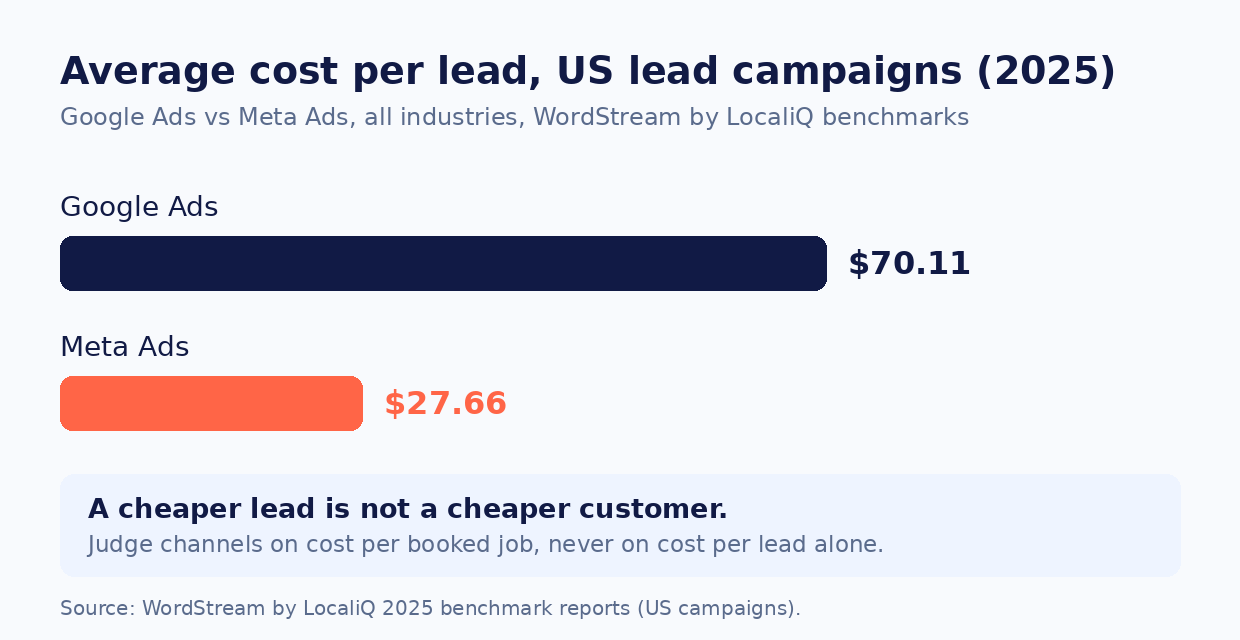
Run the illustration honestly. At benchmark costs, a $3,000 monthly budget buys roughly 43 Google leads or roughly 108 Meta leads. If one in four Google leads books and one in ten Meta leads books, both routes land near 11 booked jobs, and the real contest moves to job value, speed, and how much follow-up each lead needs. Home services run more expensive than the all-industry average: LocaliQ’s home services data puts the average Google cost per lead at $90.92, which is exactly why the plan below spends the first month making every lead count before it spends heavily on getting more of them.
The rule that governs the whole plan: every channel is judged on cost per booked job, and nothing else. Clicks, impressions, and even leads are diagnostic numbers. Booked jobs are the verdict.
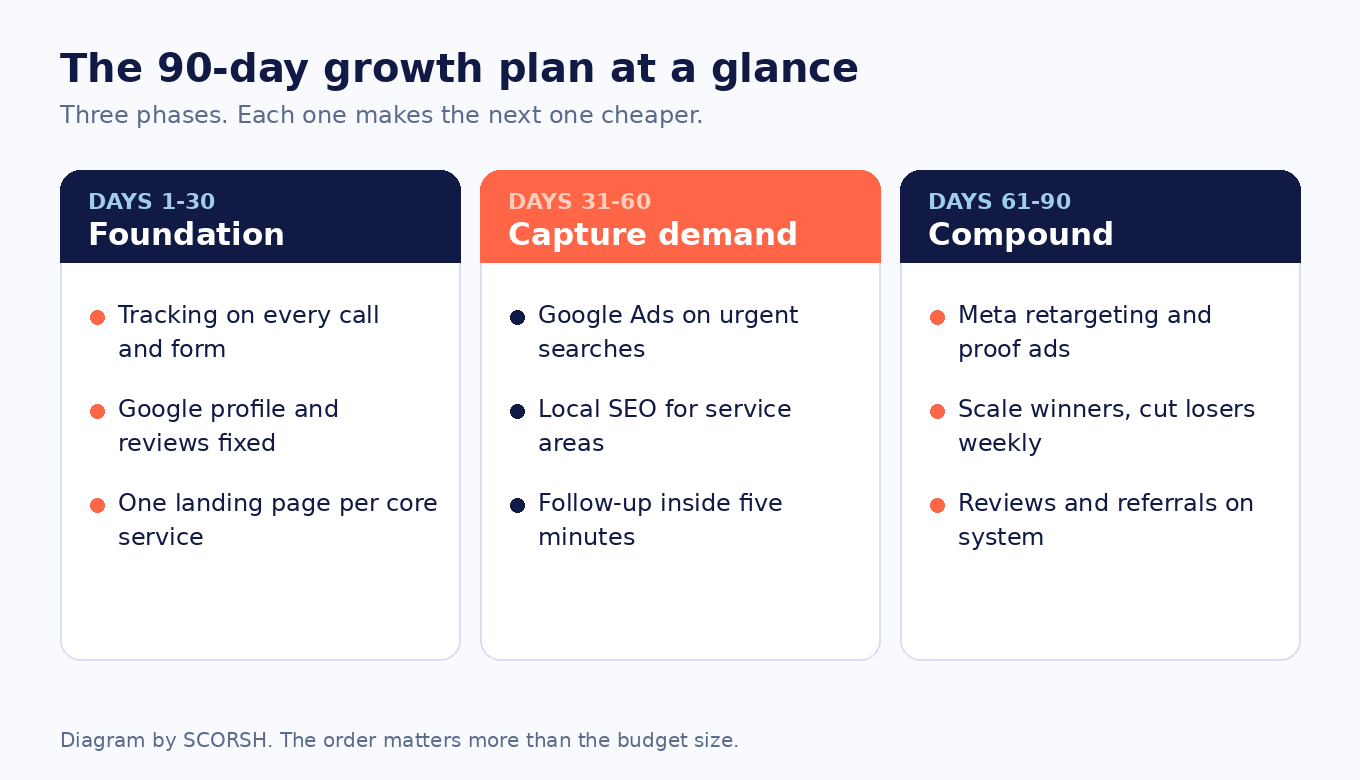
2. The Plan at a Glance
3. Days 1 to 30: Foundation
The first month produces almost no visible growth, and skipping it is the most expensive mistake in service marketing. Four builds happen here.
Tracking that survives an argument. Every phone number in every ad, profile, and page gets call tracking. Every form reports its source. The business picks one dashboard and one headline number, booked jobs, reviewed weekly. Without this, months two and three are opinions.
The Google profile and review baseline. BrightLocal’s consumer research shows 83% of consumers use Google to evaluate local businesses and 89% expect review responses. Complete the profile properly, load real photos, list every service, answer every existing review, and start the post-job review request. Our Google Business Profile ranking factors breakdown covers the ranking side in depth.
One landing page per core service. Not the homepage, and not one generic services page. Each page answers what the service includes, typical cost, timeline, and the next step, with one clear call to action. The conversion principles are the ones in our landing page CRO playbook: fewer fields, mobile first, outcome-led buttons.
A follow-up rule with a clock on it. Service leads decay in minutes, not days. Set the standard now: every new lead gets a human response within five working minutes, an automatic acknowledgement instantly outside hours, and a second and third attempt on a schedule. This single process routinely outperforms any channel change made later.
4. Days 31 to 60: Capture the Demand That Already Exists
With the foundation live, spend goes where intent already exists.
Google Ads on urgent and high-value services. Build campaigns by service, not by business: emergencies and high-ticket work first, tightly matched to the areas you actually serve, every ad landing on its own service page. Prune search terms weekly. This is the capture engine, and it is the work our Google Ads team starts every engagement with, because demand capture pays fastest.
Local SEO in parallel. Publish the service and area pages the ads are already proving valuable, keep the Google profile active with photos and updates, and grow reviews steadily. Ads buy the data on which services and areas convert. SEO then builds the free version of the same visibility, which is why these two run together rather than in separate quarters.
Measure by booking, weekly. By day 60 the business should know its cost per booked job by service, its lead response times, and its close rate by channel. Any service that cannot book profitably at benchmark-level costs has a pricing, page, or follow-up problem, and the data now shows which one.
5. Days 61 to 90: Compound
The third month adds the channels that make the first two cheaper.
Meta Ads for retargeting and proof. Now Meta gets its proper job: not cold lead generation judged against Google, but staying in front of people who already visited, searched, or enquired, with proof-led creative: finished work, real reviews, before and after results. Retargeting audiences are small and warm, so this spend is modest and its effect shows up as a rising close rate on every other channel. Our Meta Ads practice runs this as the standard third layer, and our creative testing framework covers how the ads themselves get better month over month.
The review engine at full speed. By now the request process should be automatic: job done, request sent, response posted, best reviews feeding the website and the ads. Review velocity becomes a managed metric, because it lifts the profile, the pages, and the ad conversion rate at the same time.
Scale winners, cut losers, in writing. End the 90 days with a keep, fix, or kill decision for every service and channel, based on cost per booked job. Winning services earn more budget and their own SEO content. Losers are fixed once, with a named problem, or stopped. This written review is what turns a 90-day plan into a growth system instead of a one-off campaign.
For companies that want the whole system run for them, this is the operating model behind our home services marketing work, and the trade-specific versions for plumbers, roofers, electricians, HVAC companies, and pest control companies.
6. The Weekly Scoreboard
| Metric | Healthy sign | Warning sign |
|---|---|---|
| Cost per booked job | Falling or stable as spend grows | Rising while lead volume rises |
| Lead response time | Under five minutes in working hours | Leads answered next day |
| Close rate by channel | Known, and reviewed weekly | Nobody can state it |
| Review velocity | New reviews every week, all answered | Last review is months old |
| Branded search and direct calls | Climbing month over month | Flat while ad spend climbs |
7. Five Mistakes That Break the Plan
Sending ads to the homepage. A homepage makes the visitor do the matching work. A service page does it for them. This one change routinely decides whether capture campaigns profit or bleed.
Judging Meta on cost per lead. Meta’s leads are cheaper and colder. Judged on leads, Meta always wins the report and loses the bank account. Judged on booked jobs and assisted close rate, it finds its real, valuable role.
Starting SEO with blog posts. Service businesses rank and book from service pages, profiles, and reviews first. Educational content supports those assets later. Publishing articles while the core service pages are thin is effort in the wrong order, the same sequence problem this plan exists to fix. A proper SEO programme starts with the money pages.
Slow follow-up. No channel survives a next-day callback. The fastest responder wins a share of jobs that better advertisers lose, at every budget level.
Changing everything every week. Ad platforms and search both need stable periods to learn and to measure. Change one variable at a time, on the weekly review, with the reason written down.
Frequently Asked Questions
How much budget does a 90-day plan need?
Enough to generate statistically readable results in your market: usually a minimum that buys 30 to 50 leads across the capture channels in 90 days. At benchmark costs that is roughly $3,000 to $5,000 in total ad spend for many local markets, plus the one-time foundation work. Smaller budgets stretch the same plan over a longer window rather than skipping phases.
Which channel should a service business start with?
Google, in almost every case, because it captures demand that already exists and produces the conversion data that tells you what your services and areas are worth. Meta joins in month three as retargeting and proof, where its economics work.
When does SEO start paying back in this plan?
Profile and review improvements can move calls within the first month. Service pages typically build through months two and three and compound after the plan ends, which is the point: by day 90 the business owns assets that keep producing after ad spend pauses.
Can an established business skip the foundation month?
Only the parts that genuinely exist already. If call tracking, per-service landing pages, a review process, and a five-minute follow-up rule are all live and measured, start at day 31. In our experience at least two of the four are missing in most businesses, including successful ones.
The Bottom Line
Growth for a service business is not a channel. It is a sequence: measure honestly, fix the foundation, capture the demand that exists, then compound with retargeting, reviews, and owned search visibility. Run the 90 days in that order and the end state is not a report. It is a system that books jobs at a known cost, and a business that knows exactly which lever to pull next.
If you want this plan built and run for your business, talk to SCORSH and we will start with the foundation audit.
Sources
- WordStream by LocaliQ, Google Ads and Facebook Ads benchmark reports (2025): average cost per lead $70.11 (Google Ads) and $27.66 (Meta Ads), US lead campaigns; home services Google cost per lead $90.92. https://www.wordstream.com/blog/ws/2016/02/29/google-adwords-industry-benchmarks
- Search Engine Land, Online review statistics (BrightLocal Local Consumer Review Survey data). https://searchengineland.com/guide/online-review-stats