
AI Search Visibility for Service Businesses: How to Get Recommended by ChatGPT, Perplexity and Google AI
A homeowner with a burst pipe used to scroll ten blue links and pick the business that looked most trustworthy. Increasingly, that homeowner now asks an AI assistant one question and calls the first business it names. If your company is not inside that answer, you do not exist for that customer.
This is a different game from the one most SEO advice is written for. Publisher content competes to be cited. A service business competes to be recommended: named, described accurately, and trusted enough that an AI assistant puts it in front of a customer who is ready to book. The signals overlap with classic SEO, but the order of priorities changes, and some of the most repeated advice in the industry is simply wrong.
This guide covers the service-business side of AI search: how assistants like ChatGPT, Perplexity, and Google AI choose which plumber, clinic, law firm, or roofing company to name, and the five layers a business can actually control. For the wider research on AI Overviews and organic clicks, see our AI Overviews SEO survival guide.
1. The Recommendation Is the New Ranking
Start with what the data says about clicks. Pew Research Center tracked 68,879 real Google searches by 900 US adults in March 2025. When an AI summary appeared, users clicked a traditional result in 8% of visits. Without a summary, they clicked in 15% of visits. Links inside the AI summary itself were clicked in just 1% of visits.
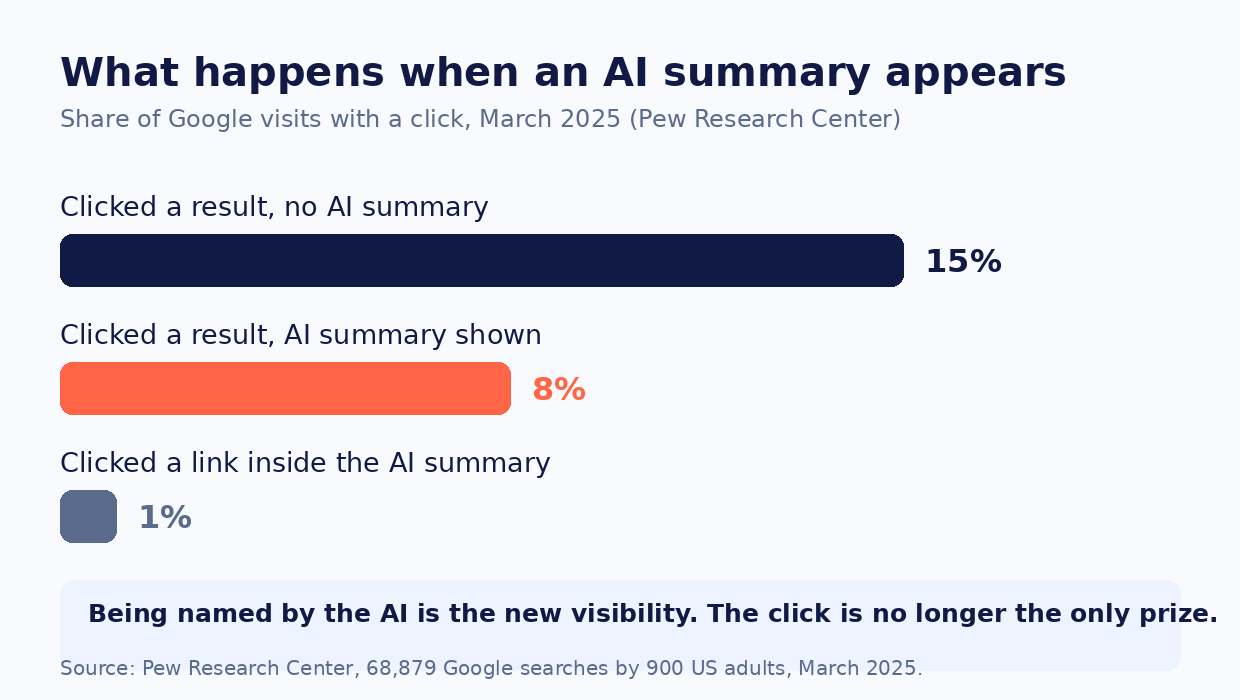
For a publisher, that is a traffic problem. For a service business, the picture is different, because local and service searches behave differently from informational ones. A customer asking “best emergency plumber near me” inside an AI assistant is not looking for an article. The assistant answers with names: usually two to five businesses, with a rating, a reason, and a tap-to-call button. The businesses in that shortlist split the demand. Everyone else gets nothing, not even a smaller share of clicks.
That is why AI search visibility for a service business is not about chasing citations on informational queries. It is about becoming the business the model can confidently recommend when money is about to change hands.
2. How AI Assistants Choose Which Business to Recommend
AI assistants do not keep a private ranking of local businesses. They assemble one at answer time, from the evidence available about your business across the web: your Google Business Profile, your website, your reviews, directories, and mentions on other sites. Three properties of that evidence decide whether you get named.
Consistency. If your name, services, service areas, and hours agree everywhere, the model treats you as one clear, real entity. If your profile says you cover one area, your site says another, and a directory lists an old phone number, the model has to guess. Models recommend businesses they do not have to guess about.
Proof. Reviews are the strongest public proof a service business has. BrightLocal’s consumer research, compiled by Search Engine Land, found that 83% of consumers use Google to evaluate local businesses, 71% read reviews always or regularly, and 89% expect businesses to respond to reviews. AI assistants read the same signals customers do, and they quote them: ratings, review counts, and the specific services reviewers mention.
Clarity. Your website has to say, in plain text, what you do, where you do it, what it costs, and how booking works. Google has been explicit about the technical side: its Search Central documentation states there are no additional requirements to appear in AI Overviews or AI Mode beyond being indexed and eligible to appear in Search with a snippet, and no special AI files or markup are needed. The bar is not a trick file. The bar is being easy to understand and easy to verify.
| Signal | Where the AI finds it | What good looks like |
|---|---|---|
| Entity data | Google Business Profile, your site, directories | Identical name, services, areas, hours and phone everywhere |
| Reviews | Google, Yelp, Facebook, industry platforms | Recent, detailed reviews, with an owner response on every one |
| Service detail | Your service and location pages | One page per service, answer first, prices and process included |
| Mentions | Local press, partners, associations, profiles | Other sites naming your business and what it is known for |
| Freshness | Dates, recent reviews, updated pages | Evidence the business is active this month, not last year |
3. The Five Layers of AI Visibility
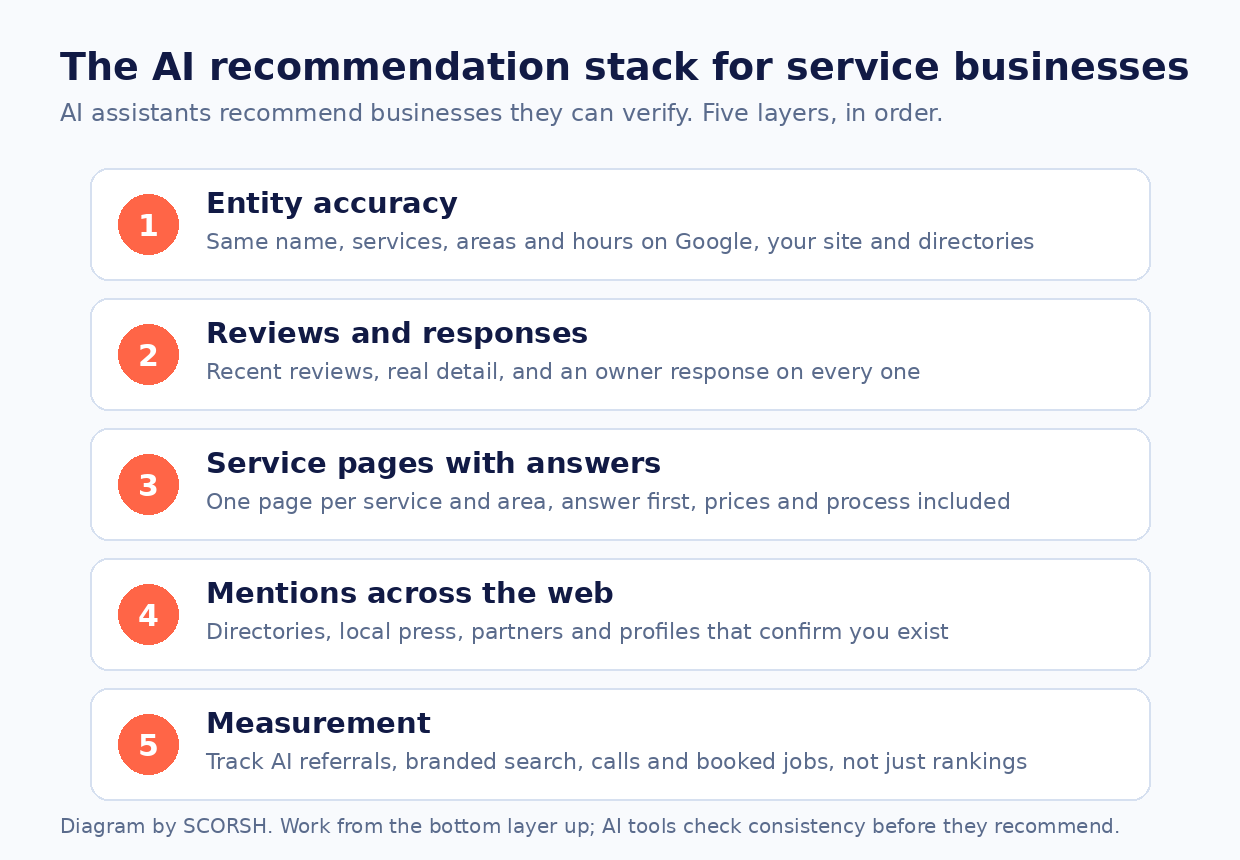
Layer 1: Entity accuracy
Audit every place your business appears: Google Business Profile, your website contact and footer details, Bing Places, Apple Business Connect, Yelp, Facebook, and the directories in your trade. Fix mismatches in name, phone, service list, service areas, and hours. This is unglamorous work, and it is the foundation everything else sits on. An AI cannot recommend a business it cannot confidently identify.
Layer 2: Reviews and responses
Build a review system, not a review hope. Ask at the moment the job finishes well, by text, with a direct link. Respond to every review, positive and negative, in a way that names the service and the area, because future customers and AI assistants both read those responses. A steady flow of recent reviews beats a large stock of old ones: recency is how both humans and models judge whether a business is still active and still good.
Layer 3: Service pages that answer real questions
One page per service, written the way a customer asks: what the service includes, what it typically costs, how long it takes, what happens after booking, and the questions customers ask before they call. Put the direct answer in the first lines of each section, because AI assistants extract answers, not introductions. This is the same discipline behind good SEO for service businesses, and it is why thin location pages with swapped city names fail in AI search even harder than they failed in classic search. Our breakdown of Google Business Profile ranking factors covers the profile side of this layer in detail.
Layer 4: Mentions across the web
Assistants trust entities that other sources confirm. Supplier and partner pages that name you, trade association listings, local sponsorships and press, podcast and video descriptions, and complete profiles on the platforms your customers use all act as corroboration. The goal is not link volume. The goal is a consistent public record that this business exists, does this work, in this area, and is known for it.
Layer 5: Measurement
You cannot manage what you do not test. Build a fixed list of 20 to 30 questions your customers actually ask, in the words they use, and run them monthly in ChatGPT, Perplexity, and Google AI Mode. Record who gets recommended, what is said about you, and which sources the answer relies on. Alongside that, track AI referral visits in your analytics, branded search volume, and the only number that settles arguments: calls and booked jobs. This is the measurement layer we build into every lead generation system, because visibility that never becomes a booking is a hobby, not marketing.
4. A 30-Day AI Visibility Sprint
Week 1: Entity audit. List every profile and directory entry for the business. Fix inconsistencies in name, phone, services, areas, and hours. Claim any unclaimed profiles.
Week 2: Review engine. Set up the post-job review request, write the owner response habit into someone’s job, and answer every unanswered review already sitting on the profile.
Week 3: Answer pages. Take your three highest-value services and rewrite their pages answer-first: what it is, typical cost range, timeline, process, and five real FAQs each.
Week 4: Baseline measurement. Run your 25 customer questions across the three assistants, save the answers, and note every factual error about your business. Those errors are your content roadmap for the next month.
Businesses that run this sprint once and then maintain the review and content habits monthly will outrun competitors who are still debating whether AI search matters. For multi-service and multi-area companies, this stack sits inside the wider system we describe on our home services marketing page.
5. What Does Not Work
Special AI files as a shortcut. Google states plainly that no new machine-readable files or AI-only markup are required for its AI features. A file can help organise information, but it is not a ranking lever, and any vendor selling it as one is selling theatre.
Fake or bought reviews. Beyond the platform penalties and the legal exposure, review fraud corrupts the one dataset AI assistants trust most about you. When it is detected, and detection keeps improving, the business loses the asset entirely.
Writing for the bot instead of the customer. Pages stuffed with robotic question repetition read badly to humans and extract badly for AI. Assistants quote clear, specific, human answers: prices, processes, timelines, and named expertise.
Chasing every new tool. The assistants change monthly. The evidence they rely on, consistent entity data, real reviews, clear service pages, and corroborating mentions, does not. Build the evidence and you are robust to whichever interface wins.
Frequently Asked Questions
How long does AI search visibility take to improve?
Entity fixes and review responses can change what assistants say within weeks, because profiles and reviews are refreshed frequently. Deeper changes, like stronger service pages and more mentions, usually show up in answers over one to three months of consistent work.
Is AI search visibility different from SEO?
It is built on SEO foundations: crawlable pages, clear content, and authority. The difference is the output. SEO wins a position on a list. AI visibility wins a recommendation inside an answer, which depends more heavily on entity consistency, reviews, and direct answers.
Can a small service business compete with national brands in AI answers?
Yes, and local intent is exactly where small businesses win. Assistants recommend based on area, reviews, and service fit. A well-reviewed local specialist with clear service pages is an easier recommendation than a national brand with a generic location page.
How do I know if AI assistants are recommending my competitors?
Ask them. Run your customers’ real questions in ChatGPT, Perplexity, and Google AI Mode, and record the names that come back. If your business is absent or described wrongly, the fixes in the five layers above are the correction path.
The Bottom Line
AI search did not remove the need for marketing fundamentals. It removed the hiding places. Businesses with accurate data, live reviews, clear service pages, and a public record of real work are exactly the businesses AI assistants can recommend with confidence. Build the five layers, measure the answers monthly, and the recommendation becomes a channel you own rather than a lottery you watch.
If you want an audit of how AI assistants currently describe your business, and a plan to fix what they get wrong, talk to SCORSH.
Sources
- Google Search Central, AI Features and Your Website. https://developers.google.com/search/docs/appearance/ai-features
- Pew Research Center (2025), Google users are less likely to click on links when an AI summary appears in the results. https://www.pewresearch.org/short-reads/2025/07/22/google-users-are-less-likely-to-click-on-links-when-an-ai-summary-appears-in-the-results/
- Search Engine Land, Online review statistics (BrightLocal Local Consumer Review Survey data). https://searchengineland.com/guide/online-review-stats